

cougr
¥
Ένα αξιοσημείωτο κείμενο γύρω από τη μεταφραστική φιλοσοφία της νομπελίστριας, Αν Κάρσον.
A place of error or mistakenness: Finding Nobel Laureate Anne Carson in translation
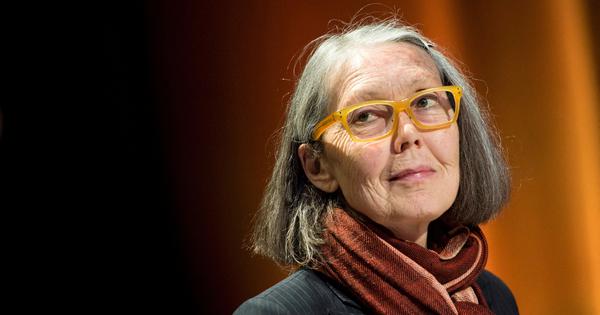
Anne Carson was awarded the 2026 Nobel Prize in Literature on October 8.
Kanupriya Dhingra
As soon as I learnt that the 2026 Nobel Prize in Literature had been awarded to poet, translator, essayist, and author Anne Carson, I felt a sense of joy in my bones. Prizes do not usually reach me this way. So, the joy took me by surprise.
For some years now, the Nobel in Literature has felt like the weather in another country. Part of that distance is structural. More than a century on, Rabindranath Tagore remains the only laureate to have written in an Indian language. Some of the most inventive writing in English today is being produced in India, by writers who have made the language bend to the rhythms of the places they write from.
That writing travels, is read, taught, and argued over across the world, yet it never seems to arrive in Stockholm. And those of us who translate from Indian languages know how much more waits at that threshold, read and loved at home, and almost unknown beyond it.
So why the joy this time? Because when I first met Carson, I did not meet her alone. She came with Sappho, carried carefully across 26 centuries and two languages. An unlikely kinship formed between the three of us – a poet and her translator sat with a reader in Delhi – made entirely of what survives. When the prize went to Carson, it felt as though that small, private company had been seen.
Fragment and form
The lyric tradition is founded on fragments. Often in my poetry classrooms, the chronology of lyric begins on Lesbos. My students will tell you that Sappho is the first voice that sings I and means a body. In Sappho, they find desire flowing like illness and a euphoria hard to tell from fear. She is said to have written nine books, but her work survives in quotes by grammarians, phrases torn on papyrus, and sometimes a single word.
In If Not, Winter (2002), Carson does not fill the breaks in the papyrus. Instead, she prints the brackets. She lets the white space stand, so the absences feel arranged and not abandoned. Since my first encounter, I have found this practice of translation to be radically honest. The brackets make worldly loss of the word visible. They tell you that the poem was eaten by time, that you are reading the remains. What remains is love in one line, and hatred with half its sentence missing – astonishingly alive, almost unbearably so.
Carson taught me that a fragment is not a failure of the whole. You can experience a poem in its entirety even when you cannot read it entirely. A fragment is a form of its own.
There are as many kinds of translators as there are readers. Some want to disappear, so the text reads as if it had always been written in English. Some bring the text home, trading its strangeness for ease. Some keep the foreignness on purpose, so the reader feels the distance travelled. Some use the original as a starting point and write their own narrative from it. Each is a choice about what to keep and what to give up.
Carson refuses the ordinary pressure on translation to strive towards smoothness, to make it read as if it were written in English and cover the joins. She keeps the joins. “I like the space between languages because it’s a place of error or mistakenness”, she told Kevin McNeilly in 2003.
A translation is always answerable to another text. In this gap between languages and centuries such responsibility loosens, and the translator is rendered free. Carson chooses and allows this freedom on every page.
Texts in motion
I read Carson’s Autobiography of Red as a companion work that took the same instinct somewhere stranger. If her Sappho refuses to fill the gaps, Red fills them openly. It begins with another fragmentary Greek poet, Stesichorus, whose long poem about Geryon, the red, winged monster Herakles kills, survives only in pieces. Carson offers her own loose, funny, anachronistic versions of those pieces, and then writes a whole novel in verse into what is missing. Geryon becomes a quiet boy who takes photographs and falls in love with Herakles, who will not love him back in the same way.
When I first read it, I wrote a note on the title page: Carson’s translator’s note. The book’s odd architecture (an essay, fragments, a novel in verse, an invented interview) felt like a translator showing her working. Whether she leaves the bracket empty or builds a world inside it, she never pretends the loss doesn’t exist.
Over the years I have read Carson’s Sappho in private, in classrooms, and aloud in public rooms. The fragments seem to behave differently in each. Alone, they are places to rest. In a classroom, the brackets start arguments. Should we guess what was there? Will the guessing harm the meaning made available? Read aloud, they become silences a room has to sit through together. Few texts change so completely depending on who is holding them and with whom.
Perhaps it is a mark of a good translation, and a good translator, who can keep the text moving. Sappho has been reaching us in pieces for two and a half thousand years, and Carson taught many of us to read those pieces without apology.
The Swedish Academy said that almost all of Carson’s work sits where “the philologist’s obsession with words” meets “the poet’s desire for new meaning”. This statement describes translation as much as poetry. To translate is to be obsessed with a word you will never fully possess. To make something new anyway. That, possibly, is why I felt joy. For once, the prize seemed to be looking at the gap, at the bracket, at the unfinished line, and calling it literature.
 scroll.in
A place of error or mistakenness: Finding Nobel Laureate Anne Carson in translation
Anne Carson was awarded the 2026 Nobel Prize in Literature on October 8.
Kanupriya Dhingra
As soon as I learnt that the 2026 Nobel Prize in Literature had been awarded to poet, translator, essayist, and author Anne Carson, I felt a sense of joy in my bones. Prizes do not usually reach me this way. So, the joy took me by surprise.
For some years now, the Nobel in Literature has felt like the weather in another country. Part of that distance is structural. More than a century on, Rabindranath Tagore remains the only laureate to have written in an Indian language. Some of the most inventive writing in English today is being produced in India, by writers who have made the language bend to the rhythms of the places they write from.
That writing travels, is read, taught, and argued over across the world, yet it never seems to arrive in Stockholm. And those of us who translate from Indian languages know how much more waits at that threshold, read and loved at home, and almost unknown beyond it.
So why the joy this time? Because when I first met Carson, I did not meet her alone. She came with Sappho, carried carefully across 26 centuries and two languages. An unlikely kinship formed between the three of us – a poet and her translator sat with a reader in Delhi – made entirely of what survives. When the prize went to Carson, it felt as though that small, private company had been seen.
Fragment and form
The lyric tradition is founded on fragments. Often in my poetry classrooms, the chronology of lyric begins on Lesbos. My students will tell you that Sappho is the first voice that sings I and means a body. In Sappho, they find desire flowing like illness and a euphoria hard to tell from fear. She is said to have written nine books, but her work survives in quotes by grammarians, phrases torn on papyrus, and sometimes a single word.
In If Not, Winter (2002), Carson does not fill the breaks in the papyrus. Instead, she prints the brackets. She lets the white space stand, so the absences feel arranged and not abandoned. Since my first encounter, I have found this practice of translation to be radically honest. The brackets make worldly loss of the word visible. They tell you that the poem was eaten by time, that you are reading the remains. What remains is love in one line, and hatred with half its sentence missing – astonishingly alive, almost unbearably so.
Carson taught me that a fragment is not a failure of the whole. You can experience a poem in its entirety even when you cannot read it entirely. A fragment is a form of its own.
There are as many kinds of translators as there are readers. Some want to disappear, so the text reads as if it had always been written in English. Some bring the text home, trading its strangeness for ease. Some keep the foreignness on purpose, so the reader feels the distance travelled. Some use the original as a starting point and write their own narrative from it. Each is a choice about what to keep and what to give up.
Carson refuses the ordinary pressure on translation to strive towards smoothness, to make it read as if it were written in English and cover the joins. She keeps the joins. “I like the space between languages because it’s a place of error or mistakenness”, she told Kevin McNeilly in 2003.
A translation is always answerable to another text. In this gap between languages and centuries such responsibility loosens, and the translator is rendered free. Carson chooses and allows this freedom on every page.
Texts in motion
I read Carson’s Autobiography of Red as a companion work that took the same instinct somewhere stranger. If her Sappho refuses to fill the gaps, Red fills them openly. It begins with another fragmentary Greek poet, Stesichorus, whose long poem about Geryon, the red, winged monster Herakles kills, survives only in pieces. Carson offers her own loose, funny, anachronistic versions of those pieces, and then writes a whole novel in verse into what is missing. Geryon becomes a quiet boy who takes photographs and falls in love with Herakles, who will not love him back in the same way.
When I first read it, I wrote a note on the title page: Carson’s translator’s note. The book’s odd architecture (an essay, fragments, a novel in verse, an invented interview) felt like a translator showing her working. Whether she leaves the bracket empty or builds a world inside it, she never pretends the loss doesn’t exist.
Over the years I have read Carson’s Sappho in private, in classrooms, and aloud in public rooms. The fragments seem to behave differently in each. Alone, they are places to rest. In a classroom, the brackets start arguments. Should we guess what was there? Will the guessing harm the meaning made available? Read aloud, they become silences a room has to sit through together. Few texts change so completely depending on who is holding them and with whom.
Perhaps it is a mark of a good translation, and a good translator, who can keep the text moving. Sappho has been reaching us in pieces for two and a half thousand years, and Carson taught many of us to read those pieces without apology.
The Swedish Academy said that almost all of Carson’s work sits where “the philologist’s obsession with words” meets “the poet’s desire for new meaning”. This statement describes translation as much as poetry. To translate is to be obsessed with a word you will never fully possess. To make something new anyway. That, possibly, is why I felt joy. For once, the prize seemed to be looking at the gap, at the bracket, at the unfinished line, and calling it literature.
A place of error or mistakenness: Finding Nobel Laureate Anne Carson in translation
Anne Carson was awarded the 2026 Nobel Prize in Literature on October 8.
scroll.in